a senior product designer
who builds interfaces that disappear into the experience, guiding users forward without a second thought.
Melbourne, AU
Daily Crime Reports Down 80%
Redesigning trust, not just the streets
Overview
The Seoul Government
Service Design
Public Safety
Community Engagement
Role
Research
Solution Design
Presentation
Implemented by the execution team
Collaborate with
Policy Expert
Community Engagement Lead
Urban Planner (CEPTED)
Project Manager

Hoegi-dong is a dense, low-rise residential village in Seoul, selected by the Seoul Metropolitan Government as a pilot site for a neighbourhood safety initiative.
Through ethnographic research and resident interviews, I uncovered a critical root cause behind the area's rising crime reports.
The core issue wasn't the physical environment alone. It was indifference, residents disconnected from public spaces and from each other, which weakened the community's natural sense of ownership and safety.
With no meaningful interaction between neighbours, minor incidents went unnoticed and unreported, contributing to a persistent average of 7 to 8 daily crime reports.
Impact Summary
80% Reduction in Daily Crime Reports
Sustained, Safer Community
National Recognition
Problems
82 out of 214 residents (38.2%) expressed concerns about their neighbourhood's safety. Daily crime reports averaged 7 to 8 incidents, a persistent source of anxiety for the community.
Physical improvements like CCTV and lighting existed, but they weren't enough on their own.
Voluntary wardens absorbed the burden of unreported minor incidents, as police response was limited to serious cases only, leaving a gap in everyday safety.
The Core Insight
Why environmental fixes alone weren't enough
CCTV and lighting made people feel watched, not safe.
What residents actually needed was to trust the people around them.

Before
“A suspicious person is behind me. If he attacks me, I can’t do anything.”

CPTED (only environmental improvement)
"I think he can't easily attack me because of a camera. But I'm not sure someone will help me."

Solutions with social connection
I can comfortably walk at night, because I know quite a few neighbours. If he harms me, I believe they'll help me out."

Before
"I don't care if this space is clean or not. I can see that nobody is trying to maintain it. I don't have any reason to care about it."

CPTED (only environmental improvement)
"I don't think it'll be a problem even if I don't care about it. It isn't my place."

Solutions with social connection
"I would like to maintain this space clean because I need to sell some stuffs. it's good for both myself and customers. And this place will be used by others as well. I don't want to cause inconvenience to them."
Cameras and lighting reduced opportunity.
They didn't reduce fear.
The missing piece was trust between neighbours,
and that had to be designed for.
Research Process
Ethnographic study


University and lab congested area
Single-person temporary households only for study densely populated the area
People in their 20s and 30s accont for 45% of the total population of Hoegi-dong
Interview
Temporary residents
in their 20s
"I quite often move around in the same neighborhood since the contracts I normally receive are short-term. I feel anxious when I encounter a stranger, even if it's just the postman. My neighbors aren't very welcoming, but I don't mind it too much."
Local people
in their 40-50s
"I worry about my teenage kids every day, especially when they're on their way back home. I teach them to be careful with strangers, even though the people live in the same building. It's a shame there's no space to have conversations with neighbors."
Voluntary wardens
"The police don't respond unless it's a serious case, so people often report minor incidents to us instead, but that's not really our responsibility. We can't handle every small case since we have our own jobs to manage as well."
Field observation

Persona

“I prefer to walk in a wide and bright street at night where there are many pedestrians, even though it takes a longer time to get home.”
Name: Seong-Eun Kim
Age: 22
Occupation: Student
Location: Hoegi-dong, Seoul (residing for 2 years)
Hometown: Gyeonggi-do
Education: Studying in BA Marketing, Kyung Hee University
lifestyle: Single
Hobbies: Hangout with friends, watching movies
Personality: Easygoing, outgoing, social, cheerful
User Goals
- To find safe walking routes at night
- To hang out at night with friends and get back home safely without anxiety

”I’m worried about my two teenage daughters when they get back home after school.”
Name: Jae-hoon Jung
Age: 45
Occupation: Engineer
Location: Hoegi-dong, Seoul (residing for 15 years)
Hometown: Gangdong-gu, Seoul
Education: Masters
Lifestyle: Married, two children
Hobbies: Reading a book, listening classical music
Personality: Introvert, kind, thoughtful
User Goals
- To make sure if my daughters are safe when they are outside
- For my daughters to feel safe and comfortable in the neighborhood.
- To help them immediately if anything bad happens to them

”I don’t want people to remember my face. I’m pretty sure they are not interested in others like me.”
Name: Gil-Tea Kim
Age: 34
Occupation: unemployed
Location: Hoegi-dong, Seoul (residing for 3 months)
Hometown: Busan
Education: Secondary school
Lifestyle: Single
Personality: Impersive, negative, a social misfit
Criminal record: Thefts, kidnap, assaults, murder, dumped body
User Goals
- To be in the blinded spaces where nobody can be aware what I am doing
Journey mapping
Our team ran a roleplay exercise, stepping into the personas we'd identified to experience the street the way residents actually do.
While the physical environment played a role, we found that people mattered even more. How residents behaved, interacted, and looked out for one another shaped the street's sense of safety far more than lighting or cameras ever could.

Affinity diagram
Grouping the research into five factors, physical, cognitive, cultural, psychological, and social, revealed a consistent pattern. Poor infrastructure (dark alleys, broken footpaths, blind spots) combined with a total lack of familiarity between neighbours, no one knew each other, no one trusted each other, and no one felt responsible for shared spaces.
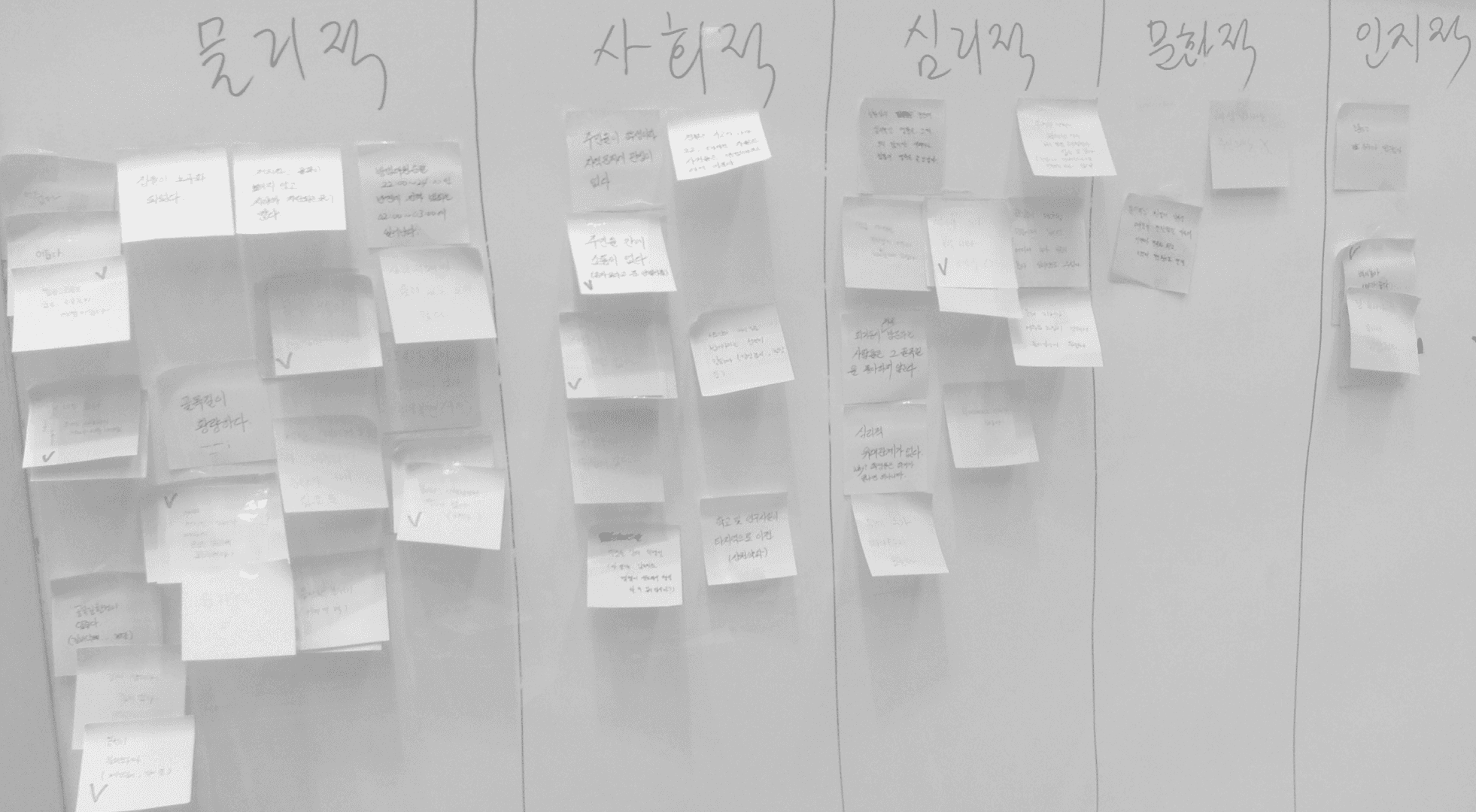
Physical
Poor infrastructure invited neglect
Cognitive
Residents didn't know their own safety resources
Cultural
No shared spaces to build community
Psychological
Fear and distrust of neighbours
Social
Weak, disconnected social ties
The root cause: indifference.
Toward public space, it led to neglect and abandoned areas. Toward neighbours, it led to distrust and disconnection. Both fed the same outcome, an environment where crime could take hold.

Solution
Solution strategy

Solve a personal need, and a connection happens as a side effect.
Residents use these services for themselves, not to "meet their neighbours", but familiarity builds naturally along the way.

Service 1. Neighbours receive packages on behalf of each other

Individual problem:
Nervousness when encountering an unfamiliar mail carrier as a single woman living alone.
Social interaction:
Communication between the neighbour holding the package and the resident picking it up.

Service 2. Flea market

Individual problem:
Constantly dealing with the disposal and acquisition of items due to frequent relocations within the same area.
Social interaction:
Communication during the exchange of used goods.

3. Community garden

4. Small talk bench

5. Alley gallery

6. Outdoor cinema

Achievement
80% Reduction in Daily Crime Reports
Following implementation, average daily crime reports dropped from 7-8 incidents to 1-2, a substantial and sustained decrease.
Sustained, Safer Community
Beyond the numbers, the residential community remained active and connected, making the village both safer and more enjoyable to live in.
National Recognition
The project's impact was formally recognised with an award in the Korea Public Service Design category, setting a benchmark other areas have since looked to replicate.


Quote variation management 🔒
A connected workflow that helps businesses change project scope without losing financial history
B2B SaaS
Workflow
Financial
Version Control

To help new users reach value faster, without limiting the flexibility advanced users needed.
B2B SaaS
Time-to-Value
Data Analytics